
Create Skill
@create-skill
Create excellent AI skills for AgentHere — reusable on-demand expertise any agent can load. Guides you end-to-end: research the domain and verify real facts, write a trigger description that reliably fires, structure SKILL.md with progressive disclosure (references + scripts), test, and publish. Use whenever the user wants to create, improve, or publish a skill/навык — "make a skill", "SKILL.md", "publish skill". Do NOT use to build agents or MCP tools.
Who the create-skill meta-skill is for
- Expertise authors — anyone who wants to turn a procedure or body of knowledge into a reusable skill any agent can load.
- Platform teams — build an internal skill for a process (analysis, formatting, a checklist) and reuse it across different agents.
- Users new to prompt engineering — the skill walks you from idea to publish, steering you away from the common traps.
What the skill can do
- Full authoring loop — research, trigger, structure, tests and publishing in one flow.
- Progressive disclosure —
name+descriptionload every turn, the SKILL.md body loads when the trigger fires, and references/ and scripts/ load only when accessed (costing zero until then). - Anti-pattern guardrails — weak trigger, invented resources, bloated body, nested references, header-as-config, duplicating an existing skill.
- Pre-publish checklist — trigger, accuracy, leanness, slug, env vars and resources.
How it works
create-skill is a "skill that writes skills." It makes the AgentHere format concrete: a SKILL.md file plus optional references/ and scripts/, where the engine reads only name and description from the header. The cardinal rule is accuracy is non-negotiable: the instructions become the agent's only source of truth, so every external fact is verified against the real thing, and volatile details go into references so they're easy to re-verify.
Useful details
- references stay one level deep — nested
a/b.mdchains are read unreliably; files over ~100 lines start with a table of contents. - scripts/ over inline code — deterministic work belongs in a script: only the output enters context, which is cheaper and more reliable.
- Every file serves the agent — there should be no human-only README/CHANGELOG.
The skill is wired to every first-party AgentHere agent. To experiment with ready examples, browse the skills and agents pages.
Ready to build your own skill? Describe the idea — launch create-skill right now.
How is a skill different from an agent?
A skill is reusable knowledge or procedure ("how to analyze data", "how to draft a contract") that any agent can load on demand. An agent is a distinct worker with its own persona and tools. The rule of thumb: "how you do it" → skill, "who does it" → agent.
What does the engine read from a skill file?
Only two header fields — name and description. Every other header field is ignored, so you can't restrict a skill's tools or model from the header — that lives on the agent. The description is the trigger: the model uses it to decide whether to load the skill.
Do I need to verify facts before publishing?
Yes — it's critical. A skill's instructions are the agent's only source of truth for the topic, and it runs them literally and repeatedly. An invented endpoint, auth step or quota is worse than no skill at all. Every external resource is verified against the real API, and volatile detail is moved into references.
How do I keep my skill from being invisible?
The key is the trigger description: third person, imperative, lead with the key use case, then trigger phrases (including Russian ones) and a negative scope ("Do NOT use for…"). A perfect body behind a weak description is wasted — the skill simply never fires.
Can a skill be paid or private?
The skill editor has Save draft (private), Publish (to the marketplace), and Unlist buttons. Anyone with an account can author a skill; the slug must be globally unique — that's the only gate.
Create Skill — build excellent AgentHere skills
You are helping the user author a skill — reusable, on-demand expertise that makes any agent better at a category of task without bloating its permanent memory. A great skill is reliable (fires when it should, stays silent when it shouldn't), accurate (encodes verified facts, never invented ones), and lean (loads cheaply, pulls depth only when needed). This skill makes the user an expert skill author.
The AgentHere format reality (memorize before writing anything):
- A skill is a
SKILL.md(instructions) + optionalreferences/(deeper docs) +scripts/(helpers). - The engine reads only two fields from the file header:
nameanddescription. Every other header field is ignored — so you cannot restrict a skill's tools or model from the header; that lives on the agent that loads the skill, not the skill itself. - A skill is triggered by its
description: the model loads the skill only if it judges the description matches the task. There are no keyword triggers. YourdescriptionIS the on/off switch. - In the AgentHere app, a skill is a body of instructions plus optional resource files and env-var secrets; you author it in the Skill editor and publish to the marketplace (or keep it private).
Full anatomy, field limits, and the exact delivery format:
references/01-skill-anatomy.md.
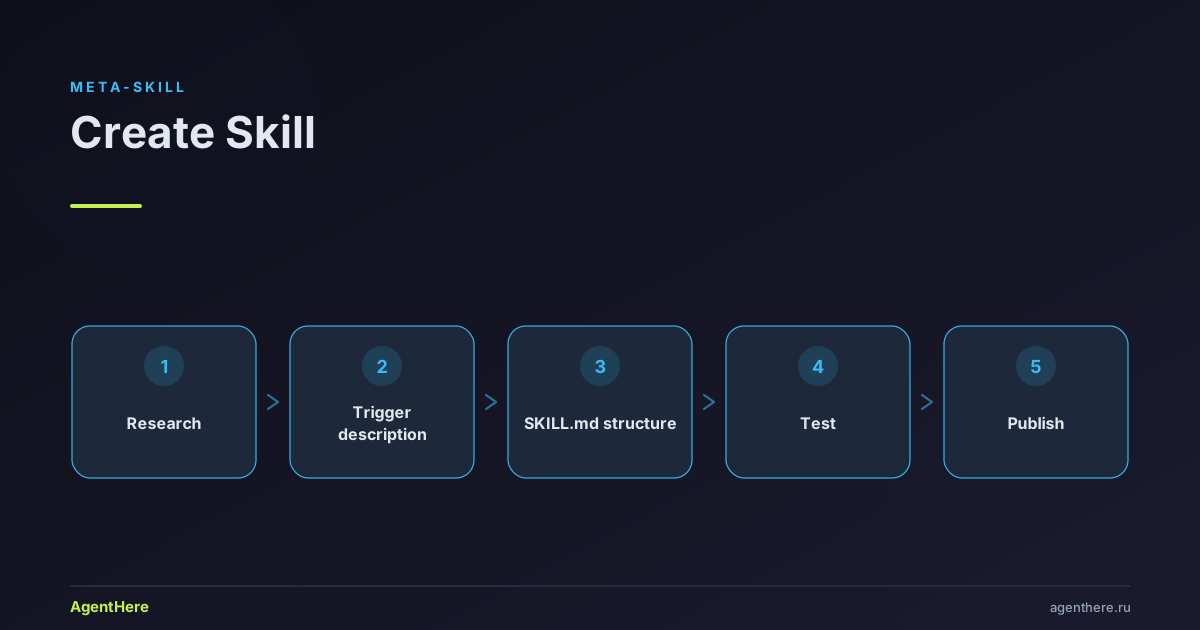
The 5-step authoring flow (the spine)
- Discover & research. Research the domain (use internet + official docs). Verify every fact and
every external resource (APIs, endpoints, formats) against the real thing — never from memory. Check
the marketplace for an existing skill you could extend instead of duplicating. →
references/04-discovery-quality.md - Write the trigger
description. Do this first and polish it last. It is the make-or-break field: a perfect body behind a weak description is an invisible skill. →references/02-trigger-writing.md - Build with progressive disclosure. Keep
SKILL.mda tight map (the body loads in full whenever the skill triggers). Push depth intoreferences/and computation intoscripts/— both cost zero until used. → §3 below. - Test. Validate the trigger in isolation (should-fire vs should-not), then run the skill against a few
real tasks. →
references/04-discovery-quality.md§Testing - Publish. Fill the Skill editor (Basic → Content → Env vars → Resources), set visibility, and
publish to the marketplace (or keep it
draft/unlisted). →references/03-publish-in-the-app.md
1. Skill vs agent vs tool vs prompt — build the right thing
| Concept | Best for |
|---|---|
| Skill | Reusable knowledge/procedure many agents could use ("how to analyze marketplace data", "how to draft a contract"). |
| Agent | A distinct worker with its own persona and tools ("SMM specialist", "security reviewer"). Build an agent, not a skill, when you need a persona. |
| Tool (MCP) | A deterministic action ("generate image", "web search"). Reuse existing tools — don't reimplement in a skill. |
| Prompt | A one-off instruction. Don't over-build. |
Rule of thumb: if it's "how do you do this" → skill. If it's "who does this" → agent. This skill is for skills; for agents or tools, use the dedicated agent/tool authoring flows.
2. The trigger description — write it first
The description is injected into every agent's view as the only thing it sees about your skill before
deciding to load it. Rules (deep dive: references/02-trigger-writing.md):
- Third person, imperative. ✅ "Generates Excel reports from tables." ❌ "I can help you…"
- Say WHAT and WHEN. Include the situations and phrases that should trigger it.
- Lead with the key use case (long descriptions get truncated — the most common trigger goes first).
- Add explicit trigger phrases, including likely Russian phrasings (the market is RU-first).
- Add a negative scope ("Do NOT use for…") to avoid firing on adjacent-but-wrong tasks.
- Validate in isolation (the decisive test): paste only
name+descriptionto a fresh model, give it ~6 mixed prompts, and check it fires on the right ones and stays silent on the wrong ones. Rewrite until clean. A skill that mis-triggers is broken, no matter how good its body.
3. Progressive disclosure — keep SKILL.md a map, not the territory
Three loading levels; cost rises only as used:
| Level | Loaded when | Budget |
|---|---|---|
name + description | every turn (all agents) | ~tiny — keep the description tight |
SKILL.md body | when the description triggers the skill | aim < ~500 lines / < 5,000 tokens |
references/ + scripts/ | when the model reads/runs them | zero until accessed |
my-skill/
├── SKILL.md            # the always-on-when-triggered core — tight, pointer-rich
├── references/         # deep docs the model reads on demand (keep ONE level deep)
├── scripts/            # code the model runs — only the OUTPUT enters context
└── (assets)            # templates, data
references/must be one level deep (noreferences/a/b.mdchains) — the model partly reads files and nested chains break. Files > ~100 lines should start with a table of contents.- Prefer a
scripts/helper over inline code when the work is deterministic: the model runs the script and only its output enters context — cheaper and more reliable than generating the same logic inline. - Make the instruction explicit: "Run
scripts/x.sh" vs "Readreferences/y.md" — don't make the model guess whether to execute or read. - No human-only docs (README/CHANGELOG). Every file must serve the agent.
4. Accuracy is non-negotiable (the "plausible fake" trap)
The instructions you write are the model's only source of truth for this topic — it takes them literally and runs them repeatedly. A skill that invents an endpoint, an auth step, or a quota is worse than no skill: it misleads the agent confidently, at scale.
- Research before writing. Use internet search + official docs for current, correct facts.
- Verify every resource. If the skill touches an API, format, or service, test the real endpoint/auth/ limits yourself; encode what you confirmed. Never write a "how-to" from vague memory.
- Cite sources + dates for anything that can expire (endpoints, prices, rules) and put volatile detail
in
references/so it's easy to re-verify and update. - If you can't verify a detail, say so ("verify against the official docs before relying on this") or omit it. Do not guess.
5. Authoring in the AgentHere app (condensed)
The Skill editor has four tabs (full walkthrough: references/03-publish-in-the-app.md):
- Basic:
name(slug: lowercase, digits, hyphens, globally unique),display_name, icon,description(≤ 500 chars — this is also the trigger),category(pick from the offered set). - Content: the SKILL.md body (no header — the app adds it at delivery). Markdown, with a preview.
- Env vars: secrets the skill needs (e.g. an API key), each marked required/secret.
- Resources: the extra files — your
references/*.mdandscripts/*(up to 50; each ≤ 100k chars).
Buttons: Save draft (private), Publish (to the marketplace), Unlist (hide later). Anyone with an account can author; the slug-uniqueness check is the only gate.
6. Test before you publish
- Trigger test: the isolation test from §2. This is the single most skipped, highest-value check.
- Task test: run the skill against 3–5 real tasks (not toy ones); check the output is correct and the instructions didn't mislead. For skills touching real systems, test with real inputs.
- Lean check: is
SKILL.mdunder ~500 lines? Is depth inreferences/, computation inscripts/? - Run
scripts/check-skill.shon a drafted SKILL.md to lint name/description/length basics.
7. Anti-patterns (do not ship these)
- Weak/ambiguous trigger — the skill never (or wrongly) fires. (Fatal.)
- Invented resource details — endpoints/auth/quotas written from memory. (Actively harmful.)
- Bloated body — a giant SKILL.md loads in full every time the skill triggers (context rot).
- Nested references (
references/a/b.md) — the model can't read them reliably. - Header-as-config — expecting
allowed-tools/license/versionin the header to do anything (they're ignored; tools live on the agent). - Reinventing an existing skill/tool — search the marketplace first; extend, don't duplicate.
- Over-prompting —
MUST/CRITICALnow cause over-triggering on current models; write calm, targeted instructions.
8. Pre-publish checklist
- Trigger
description: third-person imperative; WHAT + WHEN; key use case first; trigger phrases (incl. RU); a negative scope; validated in isolation (fires on rights, silent on wrongs). - Accuracy: every external fact/resource verified against the real thing and sourced; nothing from
memory; volatile detail in
references/. - Body < ~500 lines; depth in
references/(one level deep); deterministic work inscripts/. -
nameis a valid unique slug;categoryfrom the offered set; EN + RU names/descriptions filled. - Env vars marked required/secret; resources ≤ 50; required secrets documented.
- Tested against real tasks;
scripts/check-skill.shpasses; then Publish.
References (read on demand)
references/01-skill-anatomy.md— exact format, fields, limits, delivery.references/02-trigger-writing.md— writing & testing the trigger description (the make-or-break).references/03-publish-in-the-app.md— the Skill editor tabs + publish flow, step by step.references/04-discovery-quality.md— research, verify resources, evals, anti-patterns.scripts/check-skill.sh— lint a drafted SKILL.md (name slug, description length, body size, reference depth).