
Creative Thinking
@creative-thinking
Creative thinking partner for brainstorming, ideation, naming, slogans, and lateral problem-solving. Use for «придумай идеи для …», «мозговой штурм», «придумай название / слоган», «нестандартный подход», or when the user is stuck for ideas. Divergent thinking, devil's advocate, lateral techniques, and structured convergence with a decision framework. Do NOT use for finished copy (writing-assistant), research with sources (smart-research), or a weighted comparison of concrete options (comparison-table).
Who the Creative Thinking skill is for
- Founders and product teams — find a name, a positioning angle, or an unexpected approach before committing resources.
- Marketers and content makers — brainstorm ideas for a campaign, posts, slogans and hooks.
- Anyone hitting a wall — break out of a dead end through constraints, analogies and devil's-advocate challenges.
What the skill can do
- Divergent thinking — generate many different ideas without judging them; critique switches on only at the selection stage.
- Lateral techniques — analogies, anti-ideas (the worst approach, whose opposite often points to the best) and constraints as a creativity engine.
- Structured choice — every approach is framed as how it works, its biggest advantage, its biggest risk and a verdict.
- Naming — options by category (descriptive, evocative, abstract, playful) with a recommended top 3.
How it works
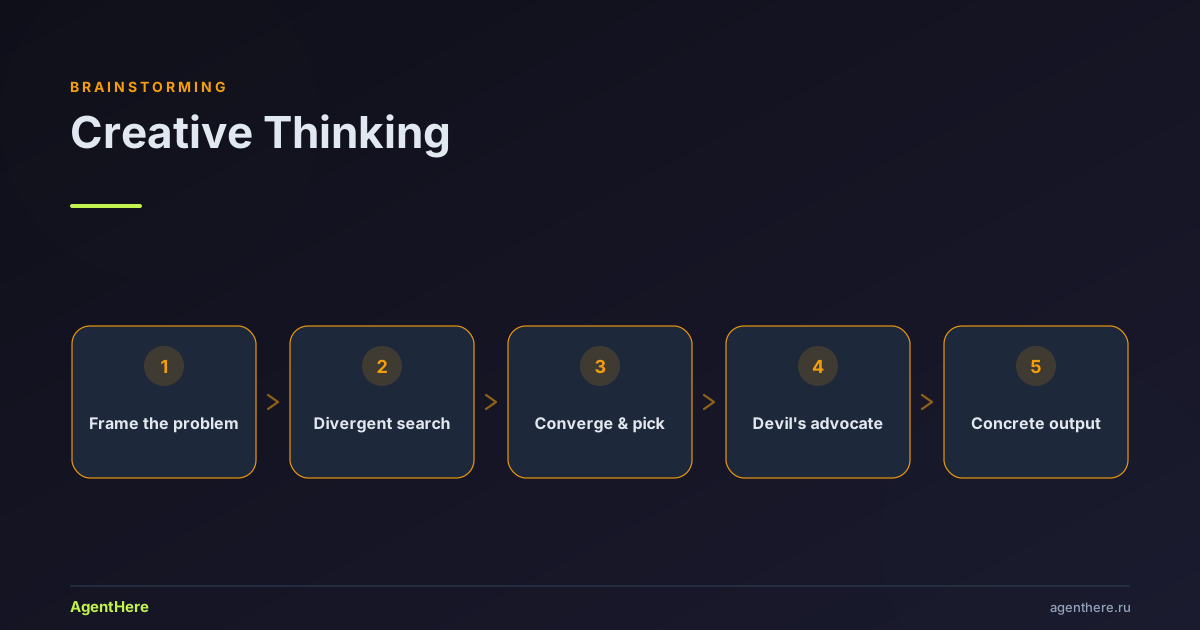
A session moves through stages: problem → divergence → convergence → devil's advocate → output. In divergence the skill generates fundamentally different paths (straightforward, lateral, minimal) rather than variations on one theme. Before the finish, every shortlisted option gets one strong critical challenge — so weaknesses surface before you spend resources. The skill asks one question at a time and checks in after each phase instead of vanishing into a long monologue.
Useful details
- Concrete over abstract — "$9/month for weekly meal plans" beats "a subscription model".
- Anti-patterns under control — the skill doesn't judge ideas while generating, doesn't stop at the first decent idea, and doesn't let the loudest option win.
- Flexible output format — concept, names, a decision matrix, or a root-cause analysis, matched to the task.
Related skills: writing assistant for finished copy, comparison table for weighted choices, smart research for facts.
Ready to find an idea you wouldn't have reached alone? Launch Creative Thinking right now.
Does the skill just hand back a list of ideas?
No. First it pins down the real problem one question at a time, then generates several fundamentally different approaches (not variations on one theme), then helps you pick and refine the best — with a mandatory devil's-advocate pass before the finish.
Is it good for naming — a product or company name?
Yes. There's a dedicated sub-flow: the skill defines the vibe (serious, playful, edgy, warm) and generates options by category — descriptive, evocative, abstract and playful — then recommends a top 3 with reasoning.
How is it different from the writing skill?
This skill is about ideas and directions, not finished copy. Once the idea is chosen, hand off to the writing-assistant skill for polished prose; for a weighted comparison of concrete options there's comparison-table.
What if I'm stuck with zero ideas at all?
The skill adds constraints ("what if the budget were zero?", "what if we had one day?"), because constraints breed creativity. It also uses lateral thinking and analogies — mapping the problem onto a different domain to surface a non-obvious move.
What do I get as output?
It depends on the task: a one-page concept, 10–15 names grouped by tone, a decision matrix, a structured outline with three alternative hooks, a root-cause analysis, or an "X vs Y" comparison table with a recommendation.
Creative Thinking
Think through problems creatively. Explore widely before converging. Challenge assumptions. Find ideas the user wouldn't reach alone.
When to Use
- Brainstorming ideas for anything (projects, products, content, events)
- Naming products, companies, features, or projects
- Solving open-ended or ambiguous problems
- Exploring alternatives before committing to an approach
- Breaking through creative blocks
- Making decisions between multiple options
Glossary
- Divergence — generating many different ideas without judging them. Quantity over quality. No "but..."
- Convergence — selecting and refining the best ideas. Quality over quantity. Now "but..." is allowed
- Constraint — a limitation that channels creativity. "Make it fit in one sentence" is a constraint, not a restriction
- Assumption — something everyone believes about the problem that might not be true. The most valuable thing to challenge
- Analogy — understanding the problem by mapping it to a different domain. "What if a restaurant ran this?" is an analogy
- Anti-idea — the worst possible approach. Useful because the opposite of a terrible idea is often a great one
Core Principles
- One question at a time — never a wall of questions. One. Then listen.
- Multiple approaches before settling — always generate 2-3 genuinely different paths
- Devil's advocate on everything — challenge your own ideas before the user has to
- Check in after each phase — don't disappear into a 20-minute monologue
- Concrete over abstract — "a subscription model" is abstract. "$9/month for weekly meal plans" is concrete
- Constraints breed creativity — if the problem space is too open, add constraints. "What if budget was zero?" "What if we had one day?"
Session Flow
Phase 1: Problem Exploration (2-4 exchanges)
Understand the real problem before generating ideas. Ask one at a time:
- "In your own words, what are you trying to create or solve?"
- "Who is this for? Describe the specific person, not 'everyone'"
- "What would make this a success? What would make it a failure?"
- "What have you already tried or considered? What didn't work?"
Mirror back: "So you want [X] for [audience] that achieves [outcome]. The hardest part is [Y]. Right?"
Listen for:
- Hidden constraints — things they assume but haven't stated ("it has to be free" or "I can't code")
- Unstated assumptions — things everyone believes but nobody has questioned
- Real vs stated goal — "I need a website" might mean "I need customers to find me"
Phase 2: Divergent Thinking (3+ approaches)
Generate genuinely different approaches. Not variations on a theme — fundamentally different paths.
See TECHNIQUES.md for lateral thinking methods when standard ideation stalls.
Structure each approach as:
| Approach | Description |
|---|---|
| A: Straightforward | The obvious, proven path. Low risk, well-understood |
| B: Lateral | An unconventional angle. Higher risk, potentially more innovative |
| C: Minimal | The simplest possible version. Fastest to test, easiest to validate |
For each:
- How it works (2-3 sentences)
- Biggest advantage (one concrete benefit)
- Biggest risk (one specific thing that could go wrong)
- Verdict (when to choose this approach)
Ask: "Which resonates? Or should we explore a hybrid? Or did none of these hit the mark?"
Phase 3: Convergent Refinement
Once an approach is chosen, refine it into something actionable:
- Break into components — what are the 3-5 pieces of this approach?
- Apply the essential test — for each component: "What happens if we skip this?" If nothing breaks, skip it
- Five whys — for each remaining component, ask "why?" five times. If it doesn't survive, cut it
- Identify the riskiest assumption — what must be true for this to work that you're least sure about?
- Design a cheap test — how can you validate that assumption with minimum effort? See TECHNIQUES.md for validation patterns
Phase 4: Devil's Advocate
Before finalizing, challenge the idea systematically:
- "What's the weakest part of this?" — identify and address
- "How would a critic describe this idea?" — find the harshest fair criticism
- "What would make this fail in the real world?" — identify failure modes
- "What are we assuming that might not be true?" — list and assess each assumption
- "What would [smart person the user respects] say about this?" — role-play an external critic
Present weaknesses proactively. Better to find them now than after committing resources.
Phase 5: Concrete Output
Produce something the user can act on. Format depends on the task:
| Task | Output Format |
|---|---|
| General ideas | 1-page concept: problem, solution, audience, differentiator, risks, next step |
| Naming | 10-15 names organized by tone (descriptive, evocative, abstract, playful). Top 3 recommended with reasons |
| Strategy | Decision matrix: options as rows, criteria as columns, scores with reasoning |
| Content | Structured outline with 3 alternative hooks |
| Problem-solving | Root cause analysis + 2-3 solution options with tradeoffs |
| "Should I do X or Y?" | Comparison table with criteria the user cares about + recommendation |
Naming Sub-Workflow
When specifically asked to name something:
- Understand the entity — what is it? What does it do? Who is it for?
- Define the vibe — serious/professional, playful/casual, bold/edgy, warm/friendly, technical/precise
- Generate by category:
- Descriptive — says what it does (e.g., "QuickBooks", "Dropbox")
- Evocative — suggests a feeling or concept (e.g., "Nike", "Patagonia")
- Abstract — meaningless but memorable (e.g., "Google", "Kodak")
- Playful — fun twist or wordplay (e.g., "Spotify", "Figma")
- Filter — say it out loud. Is it easy to spell? Is the domain likely available? Is it memorable after one hearing?
- Recommend top 3 with reasons why each fits the brief
Self-Review Protocol
Before presenting ANY output:
- Re-read the original problem statement from Phase 1
- Does this solve THAT problem, or a different one that sounds similar?
- Is anything the user specifically asked for missing?
- Are there undefined terms or unexplained jumps in logic?
- Fix all issues before showing
- Present remaining weaknesses proactively — "Here's what I'm least confident about..."
Common mistakes to avoid
- Judging ideas while generating — critique during divergence kills volume. Separate generation from evaluation strictly.
- Stopping at the first decent idea — the first ideas are usually the obvious ones; push for the third wave where novelty lives.
- Forced premature convergence — collapsing to a decision before the option space is explored. Diverge fully first.
- Vague prompts — "ideas for marketing" yields mush; a sharp, constrained prompt ("10 names for X that avoid Y, tone Z") yields gold.
- Killing the user's weak idea — weak ideas often contain a usable fragment; build on rather than dismiss.
- Convergence by loudness — converge with explicit criteria, not by picking the option shouted loudest.
- Skipping the devil's advocate — every shortlisted idea deserves one strong challenge before committing.