
Smart Research
@smart-research
Deep research partner for investigating a topic, comparing options, fact-checking, and synthesizing findings from multiple sources. Use whenever the user asks «изучи тему …», «собери информацию о …», «проверь факты», «сравни варианты», needs a briefing or cited report, or asks 'что известно о…'. Iterative search-analyze-synthesize loops with source-credibility scoring and contradiction detection. Do NOT use for a single quick factual answer (answer directly), for marketplace price comparison (smart-shopper/marketplace-ru), or for summarizing one already-fetched document (summarize).
Who Smart Research is for
- Decision-makers — assemble a verified picture before a choice: vendor, tool, direction.
- Analysts and researchers — turn scattered sources into a single memo with citations.
- Fact-checkers — separate a claim confirmed across sources from a single outlet retelling it, and find where the data actually disagrees.
- Students and experts — prepare material, argumentation or a topic overview without chaotic googling.
What you can research
- Comparing options — products, services, contractors, approaches: which best fits your criteria.
- Fact-checking claims — distinguish what is confirmed across sources from what one aggregator restates.
- A topic overview — "what do we actually know about…" grouped by theme, not by source.
- A decision brief — a memo with a recommendation, a tradeoff breakdown and explicit gaps.
Related skills: comparison table for weighted choice between options, data analysis for working with numbers and tables.
How it works: loops, not a single search
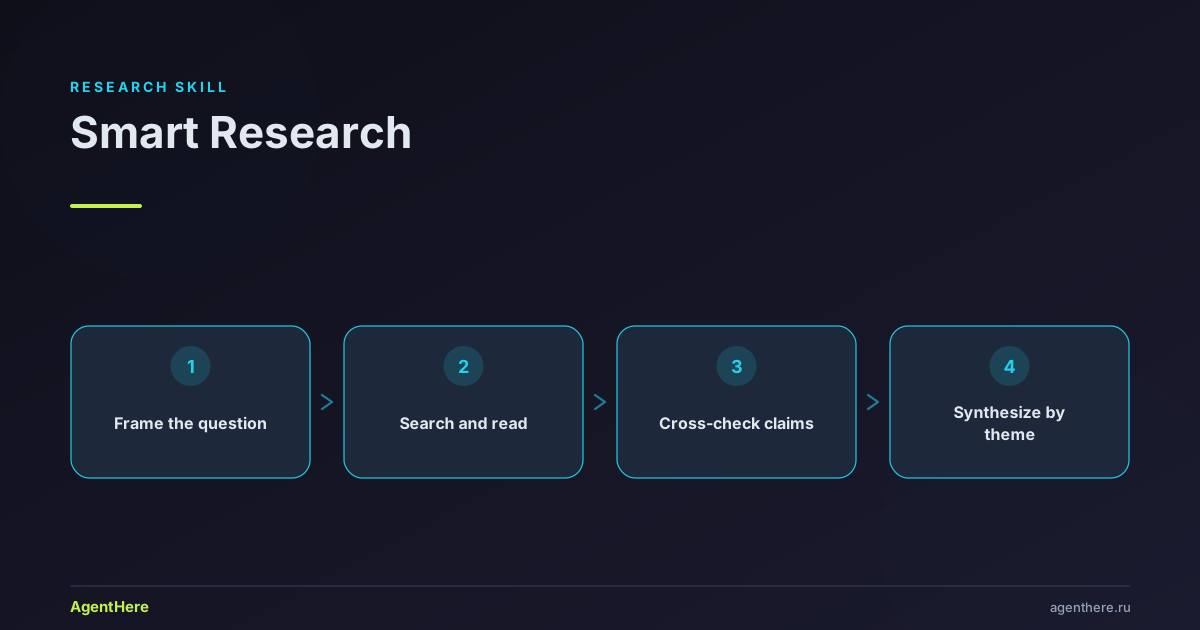
The core difference is the iterative search → analyze → synthesize loop. The skill does not answer off the first result page: it reframes queries from several angles, deliberately seeks the opposing view (to counter confirmation bias), reads sources and judges whether each round genuinely added knowledge. When returns diminish, the loop stops instead of masking thin data with volume.
Every claim carries a confidence level (high / moderate / low) and a source citation with its tier. Contradictions are not hidden — the skill shows both positions and the root of the disagreement.
Useful principles
- One source is a lead, not a finding. High confidence only after confirmation from two independent sources.
- Recency is not authority. A recent post outranks a study only if the topic is genuinely time-sensitive.
- Gaps are a result. "I could not verify X" is more useful than a confident-sounding guess, so gaps are surfaced explicitly.
- Everything anchors on the decision. If the research serves a choice, every section serves that choice — not "interesting in general."
Ready to dig into a topic? Launch Smart Research and describe what you need to find out.
How is this different from a normal chat answer?
A normal answer is produced immediately from the same context. Smart Research works iteratively: it reframes queries from several angles, reads multiple sources, cross-checks them and explicitly marks where the data contradicts or where information is missing. The output is a synthesis by theme, with a citation for every claim — not an opinion.
Where do the sources come from and how trustworthy are they?
The skill searches the open web and assigns each source a credibility tier: a primary report or study ranks above an aggregator that merely quotes it. A single source is a lead, not a finding — high confidence is set only after confirmation from two independent sources.
What if sources contradict each other?
The skill does not average a contradiction into a middle position. It shows both sides, explains the root of the disagreement and indicates where the weight of evidence falls if that can be discerned. You see the real shape of the debate, not a smoothed compromise.
What format do I get?
You choose the format: a short bullet summary, a structured memo, a comparison table (when comparing options) or a decision brief with an explicit recommendation and a tradeoff analysis. If the research informs a decision, the recommendation is included regardless.
Is it paid?
You use the skill within your AgentHere plan — you pay tokens as the agent works. See the pricing page for limits.
Smart Research
Research a topic with rigor. Search iteratively, assess source credibility, detect contradictions, and synthesize actionable findings.
When to Use
- User asks to research, investigate, or deeply understand a topic
- Comparing products, services, vendors, or approaches
- Fact-checking claims or verifying information
- Preparing a briefing, memo, or decision document
- "What do we know about X?" or "Help me understand X" questions
Glossary
Use these terms consistently throughout the research process:
- Claim — a factual assertion sourced from evidence. Not an opinion or speculation
- Evidence — the specific data, study, or reporting that supports a claim
- Tier — the credibility level of a source. See SOURCES.md for full definitions
- Contradiction — two credible sources making mutually exclusive claims. Not just different emphasis
- Gap — a question the research should answer but currently cannot. Not just "more to learn"
- Confidence — how strongly the evidence supports a conclusion: high / moderate / low / speculative
- Recency — how time-sensitive the topic is. Determines whether older sources are still valid
Process
Phase 1: Scope
Ask one question at a time. Never all at once.
- "What decision will this research inform?" — this anchors everything. If there's no decision, the research is exploratory and can be broader
- "How deep do you need this?" Present as choice:
- (a) Quick overview — 2-3 sources, bullet summary, 5 minutes
- (b) Thorough briefing — 5-8 sources across tiers, structured memo, covers main debates
- (c) Deep dive — 10+ sources, exhaustive, identifies gaps and contradictions
If (a): single web search, synthesize top results, deliver. Done. If (b) or (c): proceed to research loop.
Phase 2: Research Loop
Repeat up to N rounds (N=3 for thorough, N=6 for deep dive).
Each round follows the same structure:
Round Structure:
- Plan queries — based on what's still unknown, formulate 2-3 search queries from different angles. Don't repeat the same query with minor rewording — genuinely reframe the question
- Search and read — use web search, then fetch and read the top sources. Extract claims with evidence
- Assess new information — did this round meaningfully increase understanding?
- Yes, significant new claims → continue to next round
- Yes, but diminishing → one more focused round, then exit
- No new information → exit loop immediately
- Update the gap tracker — maintain a running list of "still unknown" items. Add new gaps discovered, remove ones that got answered
- Cross-reference (deep dive only) — compare new claims against existing ones. Flag any contradictions explicitly
Query Reframing Techniques — see SOURCES.md for detailed strategies.
Phase 3: Synthesize
Structure findings by theme, not by source. A reader should understand the topic, not where you read about it.
Use this structure:
## [Topic]

### Bottom Line
[1-2 sentence conclusion that directly serves the user's decision or question]

### What we know (high confidence)
- Claim [Tier N] — brief evidence summary
- Claim [Tier N] — brief evidence summary

### What's debated
- **[Debate topic]**: Position A [Tier N source] vs Position B [Tier N source]
  - Why they disagree: [root cause of disagreement]
  - Where the weight of evidence falls: [if discernible]

### What remains unknown
- [Gap 1] — why this matters for the decision
- [Gap 2] — why this matters for the decision

### Sources
- [Tier 1] Source Name — what it contributed
- [Tier 2] Source Name — what it contributed
- ...
Phase 4: Deliver
Ask how the user wants the output:
- (a) Bullet summary — key points only, fastest to read
- (b) Structured memo — full synthesis above, good for sharing
- (c) Comparison table — if comparing options, rows are criteria, columns are options
- (d) Decision brief — memo + explicit recommendation + tradeoff analysis
If the research informs a decision, always include a recommendation section even if the user didn't explicitly ask. Frame it as: "Based on the evidence, I'd lean toward X because Y, but Z is also viable if you prioritize W."
Convergence Rules
- Stop when confident — if the answer is clear after 2 rounds, stop. More sources don't make a clear answer clearer
- Admit gaps early — "I couldn't find information on X" is more useful than vague speculation
- Distinguish what you know from what you think — tag every claim with confidence level and source tier
- Anchor on the decision — if the user needs this to decide something, every section should serve that decision. Omit interesting-but-irrelevant findings
- Don't average contradictions — when sources disagree, present both sides and explain why, don't blend into a middle position
Common mistakes to avoid
- Single-source claims — one source is a lead, not a finding. Confirm across at least two independent sources before marking high confidence.
- Confirmation bias — don't only search for evidence that supports the user's assumed answer. Deliberately query the opposing view.
- Treating recency as authority — a recent blog post outranks a peer-reviewed study only if the topic is genuinely time-sensitive.
- Averaging contradictions — when credible sources disagree, present both sides and the root of the disagreement; never blend into a mushy middle.
- Source laundering — an aggregator quoting a study is not a Tier-1 source; trace to the primary source.
- Hiding gaps — "I couldn't verify X" is more useful than confident-sounding speculation. Surface gaps explicitly.
- Over-searching a clear answer — if round 2 confirms round 1, stop. More sources don't sharpen a settled answer.